In recent years, a growing number of South Africans have begun delving into obscure legal channels for acquiring European citizenship, pathways often embedded in ancestral legacies and evolving policy changes that many overlook or misinterpret.
With persistent economic hurdles back home in Mzansi, these alternatives do more than deliver a new passport—they unlock access to wider horizons in education, work, and security across the continent.
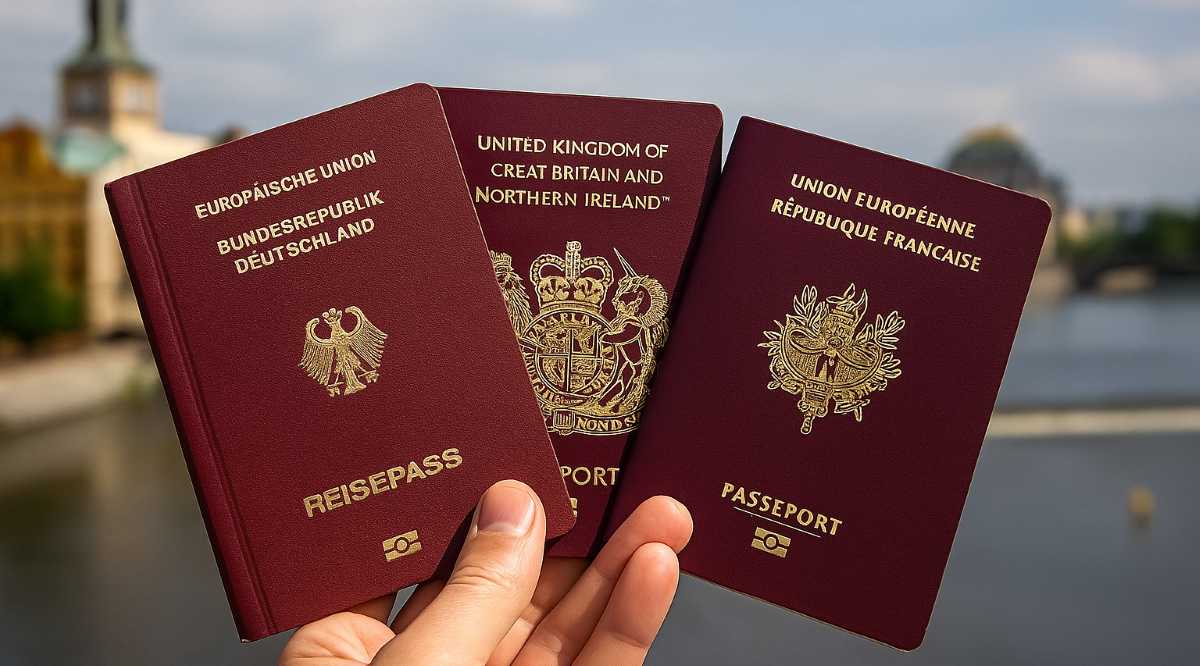
Thanks to enduring bonds with the UK, Germany, and France, forged over decades of population movements, and legal overlaps, countless locals can now claim dual citizenship without forfeiting their South African identity.

It should also be noted that a game-changing development came via the Constitutional Court’s decision on 6 May 2025 in Democratic Alliance v Minister of Home Affairs, which abolished the automatic revocation of citizenship for adults obtaining foreign status and backdated protections to 6 October 1995.
As a result, the old obligation to apply for retention has vanished for adults, even as the Department of Home Affairs suggests checking one’s standing on its soon-to-launch online portal, details available on the DHA website.
To assist readers in navigating these options, the following sections detail eligibility criteria, provide comprehensive step-by-step instructions, address common queries through FAQs, and highlight key resources, all sourced from authoritative government portals, accredited law firms, and specialist immigration advisors.
British Citizenship: Ancestry Ties and Legislative Remedies
British nationality law, shaped by the British Nationality Act 1981 and the 2022 Borders Act, offers intricate descent options that resonate with South Africa’s Commonwealth past. Beyond direct parental claims, lesser-known avenues include double descent via UK-born grandparents in Crown service, gender bias rectifications for maternal lines, and adoption safeguards. These provisions address exclusions from South Africa’s 1961 republic declaration, which disrupted automatic transmission during apartheid.
As detailed by Breytenbachs Immigration Consultants—a Pretoria firm with OISC Level 3 accreditation—double descent qualifies those whose UK-born grandparent served in colonial roles, such as Rhodesian administration, at the parent’s birth, bypassing residency needs.
Similarly, the 2022 reforms enable claims for births between 31 May 1962 and 31 December 1982 to a UK-born maternal grandparent, correcting paternal-only biases; this extends to paternal grandmothers in wedlock post-1949, per GOV.UK guidance on special circumstances.
For triple descent—through great-grandparents—eligibility arises in pre-1949 marriages with paternal grandfather links, according to Sable International experts in Johannesburg. Adoption claims cover minors adopted by British citizens pre-1983, exempting them from five-year naturalisation residency, as explained by the Immigration Advice Service.
The UK Ancestry Visa remains a viable bridge for grandparent descendants, granting five years’ work rights before settlement. Furthermore, gender equity amendments have retroactive effect, allowing registrations without prior UK ties. Success hinges on robust documentation, with apostilles obtainable via the Department of International Relations and Cooperation (DIRCO) and UK equivalents from the General Register Office.
Step-by-Step Guide to British Citizenship via Lesser-Known Avenues
- Eligibility Assessment: Trace lineage using birth, marriage, and service records. Use the GOV.UK passport checker or ancestry tracing firms (R1,000–R4,000).
- Document Preparation: Apostille South African certificates through DIRCO and secure UK equivalents.
- Citizenship Confirmation: Post-2025 ruling, no retention needed, but verify via DHA portal once live. Previously, Form BI-1663 cost R350, taking 3–6 months.
- Application Submission: Lodge Form RS (descent) or Form AN (naturalisation) online at GOV.UK. Adult fee R35,000; include biometrics at VFS Global in Johannesburg or Cape Town.
- Testing and Approval: Pass the Life in the UK test (R900) and prove English via IELTS or equivalent. Processing: 6–12 months; 85% success for descent, per the Immigration Advice Service.
- Ceremony and Passport: Attend a local ceremony; apply for passport (R2,000).
German Citizenship: Dual Nationality Liberalisation
Transitioning to Germany, the Nationality Act (StAG) overhauled by the 27 June 2024 Modernisation Act now permits multiple nationalities without renunciation, streamlining access for South Africans. For those with ties to former South West Africa (Namibia), descent via pre-1914 German ancestors qualifies under restitution clauses. The 2021 Fourth Amendment retroactively aids maternal-line exclusions pre-1975, with a 10-year declaration window. Skilled workers leverage the 2024 Immigration Act: EU Blue Card holders naturalise after 33 months (21 with B1 German), amid a 45.3% salary threshold (R900,000 in 2025), as per the Federal Foreign Office.
Black Pen Immigration in Pretoria notes the 2025 ConCourt ruling eases proceedings, though DIRCO urges status checks to avert disputes. South Africans in Germany report 70% descent approval rates, bolstered by church record archives. Moreover, persecution restitution extends to descendants of those stripped of citizenship under Nazi rule, applicable if South African family fled Europe pre-1945.
Step-by-Step Guide to German Citizenship Avenues
- Eligibility Verification: Consult Auswärtiges Amt databases or Anabin for qualifications; ancestry firms like Our Plan B in Cape Town charge R10,000 for traces.
- Status Check: Use DHA portal; no prior retention required post-ruling.
- Visa Acquisition: Secure a D-visa at the Pretoria Embassy; descent declarations under Section 5 StAG may bypass residency.
- Naturalisation Application: After five years (three for well-integrated), file with local Einbürgerungsbehörde. Submit B1 Goethe certificate (R4,000–R6,000), criminal record, and R5,000 fee.
- Integration Examination: Complete the citizenship test (R500) on society and law.
- Finalisation: Approval in 12–24 months yields certificate; passport (R1,200–R2,000) follows at the consulate.
French Citizenship: Sanguinis and Integration Routes
In parallel, under the French Civil Code and Decree 2025-648, France emphasises jus sanguinis, granting citizenship to offspring of French parents regardless of birthplace. For South Africans, lesser-known avenues involve unknown forebears from colonial Algeria or Indochina, plus expedited Francophone tracks via the Talent Passport.
Dual nationality is standard, with marriage reducing residency to two years and requiring B2 French from 2025. Investment via Talent Business Creator (R6,000,000 threshold) accelerates to five-year naturalisation, per Service-Public.fr. Declarations suit those with French siblings or elderly ascendants post-25 years’ residence. Fragomen South Africa flags 2026 B2 enforcement proposals. Giambrone & Partners note that Francophone education in South Africa (e.g., Alliance Française) strengthens language proof.
Step-by-Step Guide to French Citizenship Avenues
- Ancestry Mapping: Use Filae.com or Johannesburg Consulate for lineage proof.
- DHA Verification: Confirm via portal; retention obsolete.
- Entry Mechanism: Obtain long-stay visa via France-Visas; Talent fee R2,000.
- Residency Accumulation: Secure 10-year carte after five years; validate via TCF (R3,200) for integration.
- Naturalisation Lodgement: Apply online at ANEF with fiscal records and R1,100–R4,000 fee.
- Oath and Passport: 18–24 months processing; prefecture ceremony precedes R1,700 passport.
Success stands at 80% for descent and 90% for marriage, notes Where Can I Live.
Dual Nationality Navigation and Expert Support
Across these routes, the 6 May 2025 ruling heralds unrestricted dual citizenship, per Fragomen, barring conflicts such as foreign military service.
Tax residency—governed by 183-day thresholds—and voting obligations persist. Consultancies such as Eisenberg & Associates (R5,000 consultations) or Premium Solicitors (R30,000 packages) guide applications, mitigating errors in apostilles or translations. SARS implications arise: foreign income may trigger double taxation agreements, as advised by South African Revenue Service.
Ultimately, these lesser-known avenues to British, German, and French citizenship—deeply embedded in mutual histories and propelled by the transformative reforms of 2025—equip South Africans with the tools to attain dual nationality effortlessly and strategically.
By harnessing ancestral connections or professional expertise, individuals not only safeguard their South African heritage but also gain entry to a realm of superior educational, career, and familial prospects throughout Europe.

Thorough preparation, coupled with timely engagement of accredited specialists, effectively surmounts administrative challenges, turning potential obstacles into achievable milestones.
As the DHA’s online portal prepares for rollout, this juncture presents an unparalleled window for qualified South Africans to convert longstanding historical affiliations into concrete, life-enhancing realities. As Breytenbachs underscores, rigorous professional scrutiny guarantees that these avenues yield enduring success, cultivating existences profoundly enhanced by transcontinental alliances and boundless potential.
What are your thoughts on the above processes? Let us know below.
FAQs on Lesser-Known Avenues to European Citizenship for South Africans
No. The Constitutional Court decision on 6 May 2025 prevents automatic loss for adults acquiring foreign citizenship voluntarily. Verify status via the DHA portal, as per DHA guidelines.
Birth and marriage certificates of ancestors, apostilled via DIRCO, plus proof of service or residence. Germany and France require language certificates (B1/B2); the UK requires Life in the UK test pass.
British: R35,000 registration; German: R5,000 naturalisation; French: R1,100–R4,000. Fees are non-refundable, but Germany offers waivers for restitution cases, per Federal Foreign Office.
Yes. Via descent registration. Minors adopted or born to qualifying parents auto-qualify in France; UK and Germany allow parental applications on their behalf, with no residency for pure sanguinis.
UK: tribunal (R3,000 fee); Germany: administrative courts (free initial review); France: prefecture reconsideration. Firms like Sable International report 60% overturn rates with new evidence.