

Estimated reading time: 8 minutes
PwC, a professional services firm, has released its latest economic outlook for South Africa, highlighting how much work is required for government entities to succeed.
PwC notes that municipalities’ financial health is critical for service delivery and the country’s socioeconomic recovery in the short to medium term.
“Municipalities require adequate funds to provide the essential services needed to create an environment conducive for doing business and growing the economy following last year’s recession. To fund those services, they rely on a mix of transfers from the national government and their own revenue sources,” the firm states in its report.
In response to the COVID-19 pandemic, the National Treasury increased transfers to local governments by a significant (12.6%) in the equitable share of local governments during the 2020/2021 fiscal year, with a portion of the funds set aside for COVID-19 response measures.
PwC notes, however, that the budget for the fiscal year 2021/2022 sees some of this clawed back, with total transfers reduced from R138.5bn to R138.4bn.
“While conditional grants are being increased from R40.0bn to R45.5bn, the equitable share is being reduced from R 84.5bn to R78.0bn. With transfers from the national government falling rather than rising, municipalities need to rely more on their own revenue, predominantly from property rates and service charges for electricity, water, sanitation and refuse.”
However, as municipalities have raised their rates and charges, the amount of debt owed to them has grown, according to PwC.
Metropolitan municipalities owe a total of R114.5 billion.
This is a significant (nearly 60%) increase from the R72.4bn owed in mid-2018.
Furthermore, PwC notes that the latest Auditor-General of South Africa (AGSA) report indicates that 163 out of 257 municipalities, or nearly two out of every three, are currently in financial distress.
The Municipal Finance Management Act (56 of 2003) defines this as either:
- ‘serious financial problems,’ which include, among other things, defaulting on financial obligations; actual expenses exceeding actual income for more than two consecutive years; or a deficit in its operating budget equal to 5% of total revenue.
- ‘financial crisis,’ when the aforementioned factors are continuous and there is a recurring failure of the municipality to pay its debts in such a way that it significantly impairs its ability to procure goods, services, or credit on normal commercial terms.
Furthermore, PwC notes that the Public Affairs Research Institute’s (PARI) 2020 report argued that the state of South Africa’s municipalities was unsustainable, with the fiscal framework creating structural problems that hampered the country’s development.
“Despite the important role of local government in supporting socioeconomic development, PARI demonstrated that municipalities are largely unable to fund the services they are constitutionally mandated to provide,” the firm says.
As several municipalities face financial difficulties, PwC believes that resolving the municipal finance crunch will necessitate a data-driven financial and economic planning approach.
According to the firm, their approach is to assist municipalities in understanding their situation’s financial and economic aspects.
Metros’ medium-term projections indicate a greater reliance on revenue increases from service charges to fund growing expenditure requirements.
However, the firm explains, this puts additional strain on households and businesses, negatively impacting the country’s socioeconomic recovery.
According to the firm, as unemployment continues to rise, the percentage of indigent households qualifying for free essential municipal services has increased in some metros. This could mean further tariff increases on rates charged to those who pay for municipal services to cover costs.
“Indeed, over the past 18 months, we have seen many instances of lower municipal revenue collections and higher instances of indigence requiring an increase in tariffs to sustain service delivery.”
It is important to note, as PwC explains, that the increase in tariffs puts financial pressure on businesses and households and their ability to pay for these services.
“This, in turn, translates into increased defaults and lower collection of revenues. This again requires an increase in tariffs, continuing the cycle. It is very difficult to get out of this spiral. PwC’s approach is to help municipalities not only understand the financial aspects of this situation but also – and firstly – the economics.”
Municipalities must understand the current state of their local economy, how it has changed, and how it is likely to change in the future.
This is the environment in which municipal leaders must operate and make decisions, according to the firm. Each municipality has a distinct mix of economic sectors that will experience varying trends as the economy recovers overall.
As a result, the overall economic recovery of each municipal area may differ from that of its neighbours. To truly understand the municipality’s current and likely future economic dynamics, it is important to understand the local economy’s exposure to the country’s various sectors and industries.
Finally, a municipality’s potential revenue base is determined in this economic climate – both locally and nationally.
When it comes to this topic, PwC says there are a few key questions to consider. These are:
- How do we support industries to have the maximum beneficial impact?
- Do we stimulate growth in sectors with strong potential?
The answers to these questions contribute to more accurate forecasts of local industry growth, property values, household income, and employment levels.
According to PwC, this knowledge is then used to analyse the financial situation.
PwC pursues the following goals as part of its methodology for unpacking the revenue situation:
- Recognise revenue and collection sources (who is contributing how much)
- Understand customers’ circumstances and their ability to pay
- The economic impact on municipal finances
- Determine the likely future revenue and collection based on economic conditions.
- Identify revenue streams to ensure that everyone contributes fairly.
- Test the impact of specific decisions or circumstances on customers and municipalities.
PwC’s data-centric approach to understanding municipal finances are structured in four stages, as shown in the table below:

“As with private sector companies worldwide, digital tools and data technology now allows municipalities to interact with this information on a real-time basis. This, in turn, empowers decision-makers to understand the economic and financial dynamics in their municipality for effective, impactful decision making,” it explains.
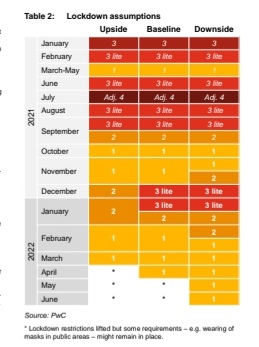
As municipalities face significant challenges, PwC’s economic outlook includes scenarios for South Africa’s lockdown levels.
While the relaxation of restrictions was welcomed as of 1 October 2021, the South African Medical Association (SAMA) expressed concern about the increase in limits on public gatherings, according to PwC.
Current rules allowed for gatherings of 2,000 people outdoors and 750 indoors versus limits of 250 people outdoors and 100 people indoors when the country was last at level 1 during 2021Q2.
“The association stated that this ‘could be seen as political’ in advance of the November 1 elections, adding that there is no scientific evidence that the increase in numbers will be safe practise,” the firm explains.
Looking ahead, PwC reports that all of their scenarios anticipate a fourth wave of infections (of varying severity) during the summer vacation.
“With just over a quarter of adults now fully vaccinated and another 35% having received their first jab of the two-dose Pfizer, the fourth wave should be milder compared to the preceding waves.”
Nonetheless, PwC anticipates that rising infections in December will necessitate more stringent regulations during the summer vacation. PwC estimates that it will take another four months to fully vaccinate 70% of the adult population, based on the volume of vaccines already administered and the current daily rate of injections.
This implies that lockdown restrictions – even if only at level 1 – could be expected as early as 2022Q1.
Now let’s take a look at PwC’s forecast:
Upside scenario:
- Level 1 lockdown to last the rest of the year, transitioning to level 2 in December.
- There is no significant increase in infections, and the country returns to level 1 lockdown in February and March.
- Lockdown restrictions are largely lifted by April 2022, with a few exceptions, such as wearing masks in public places.
Baseline scenario:
- Level 1 lockdown will be maintained for the remainder of the year, with a transition to an adjusted level 3 lockdown in December.
- Modified level 3 lockdown to continue for the majority of the holiday season, transitioning to level 2 lockdown in mid-January.
- South Africa enters a level 1 lockdown in February, which will last until May 2022.
- Lockdown restrictions are largely lifted by May 2022, with specific exceptions such as wearing masks in public places.
Downside scenario:
- Level 1 lockdown will remain in effect for the majority of the year, transitioning to level 2 lockdown in mid-November.
- Adjusted level 3 lockdown to last for the majority of the holiday season, before returning to level 2 lockdown in mid-January.
- South Africa enters a level 1 lockdown in mid-February and will remain there through the first half of 2022.
What are your thoughts, bearing all of this in mind? Share your views in the comments section below.
RELATED NEWS