



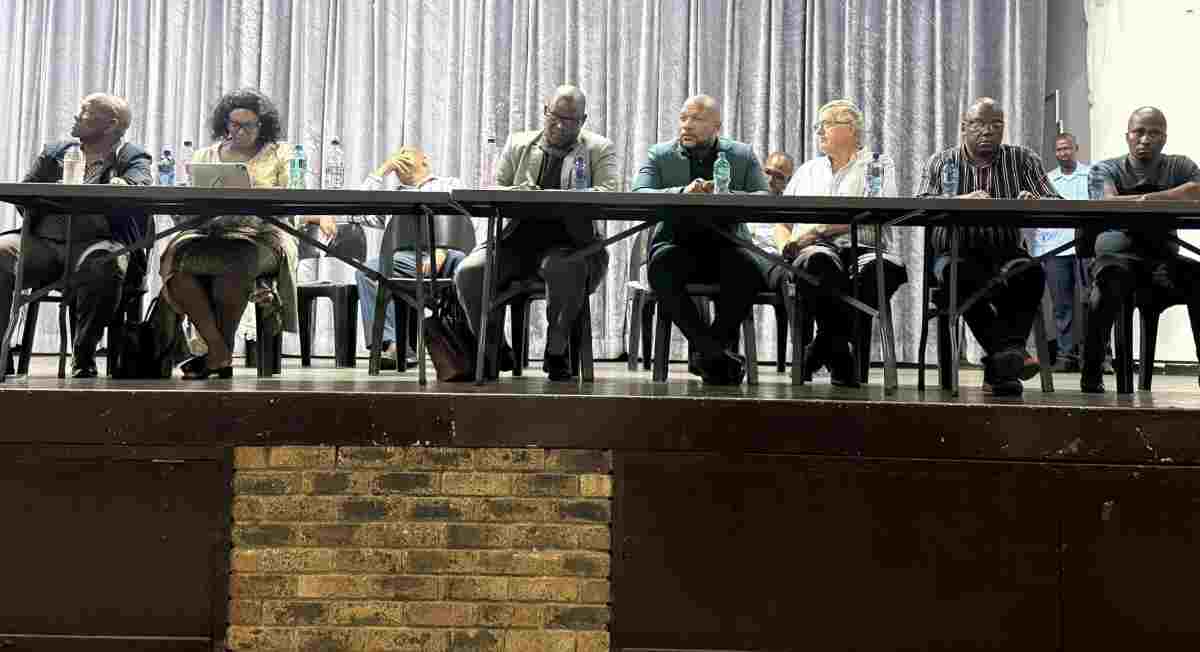
Exorbitant utility bills and failing municipal services have pushed Newcastle residents to breaking point. This frustration boiled over on Tuesday evening, 16 September 2025, when residents confronted the Newcastle Municipality’s leadership, demanding urgent answers and immediate action.
The meeting, held at the Newcastle Show Hall, drew a packed crowd whose dissatisfaction was clear from the outset.
Residents pressed officials to explain their steep utility bills, with one attendee remarking, “We pay more for our utility bills than many of the larger cities such as Durban and Johannesburg.”
One Ncandu Park resident described his ordeal: “My last utility bill was R10 000, with R5 000 for electricity alone, and it was cut off. I refuse to pay it because there is no way I used so much electricity and water during the month.”

Mayor Xolani Dube responded by assuring residents that the municipality is investigating the rate structure.
According to Dube, Newcastle’s tariffs are being benchmarked against other towns and cities to determine fairness and identify areas for improvement. He added that high municipal accounts are not unique to Newcastle but a nationwide concern, with the matter escalated to SALGA at provincial level in search of sustainable solutions.
Yet the problem extends beyond high bills.
Non-payment of accounts, particularly in Newcastle East, remains widespread. Officials admitted that the issue is eroding the municipality’s stability, with Newcastle itself owing creditors R2 billion, while Newcastle East residents collectively owe roughly the same amount to the municipality. A Newcastle West resident voiced long-standing frustration: “We’ve been hearing promises for years, but nothing changes. Now we are left to carry the financial burden.”
Service failures added to residents’ anger. Newcastle’s roads remain littered with potholes, despite repeated repairs. Motorists say the constant damage to their vehicles is an additional financial strain on top of monthly bills. Water outages, often caused by burst pipes, ageing infrastructure, or pump station failures, are also routine in several suburbs, leaving families without reliable supply week after week.
In an effort to find solutions, the meeting ended with a proposal to establish a committee of residents to work alongside municipal officials. However, confirmation of this committee’s formation is still pending.
Following the meeting, Dr Imraan Keeka acknowledged the seriousness of residents’ concerns but criticised the limited turnout:
“There are over 1 000 people on the Concerned Residents of Newcastle group, but only a fraction came tonight. I urge more people to attend, because their concerns are valid.”
The problem now stands as a defining moment for Newcastle. Mounting debts, failing infrastructure, unreliable utilities, and persistent non-payment have pushed public trust to its lowest point in years.
Residents are no longer willing to accept explanations—they are demanding accountability, transparency, and immediate, measurable reforms. The municipality’s next steps will determine whether it can restore confidence or face growing unrest within the community.

What are your thoughts on this and do you think a committee will help remedy the problem? Let us know below
Also, be sure to read, KZN Mosquito Outbreak: What Residents, Officials and Scientists Are Saying, in case you missed it







3 Responses
Replace the entire Municipal Management. Simple and easy. Jaag hulle almal weg.
They are incompetent and incapable.
This Municipality is as useless and corrupt as the Government.
Seconded,change is needed people who stay in Mhlanga and other bigger cities they don’t pay so much for electricity…this is a day light robbery
Our pensioners can’t afford the electricity bills we stay in LA Bri and my electricity is very high can’t beleive it you can’t afford food anny more of this high bills