

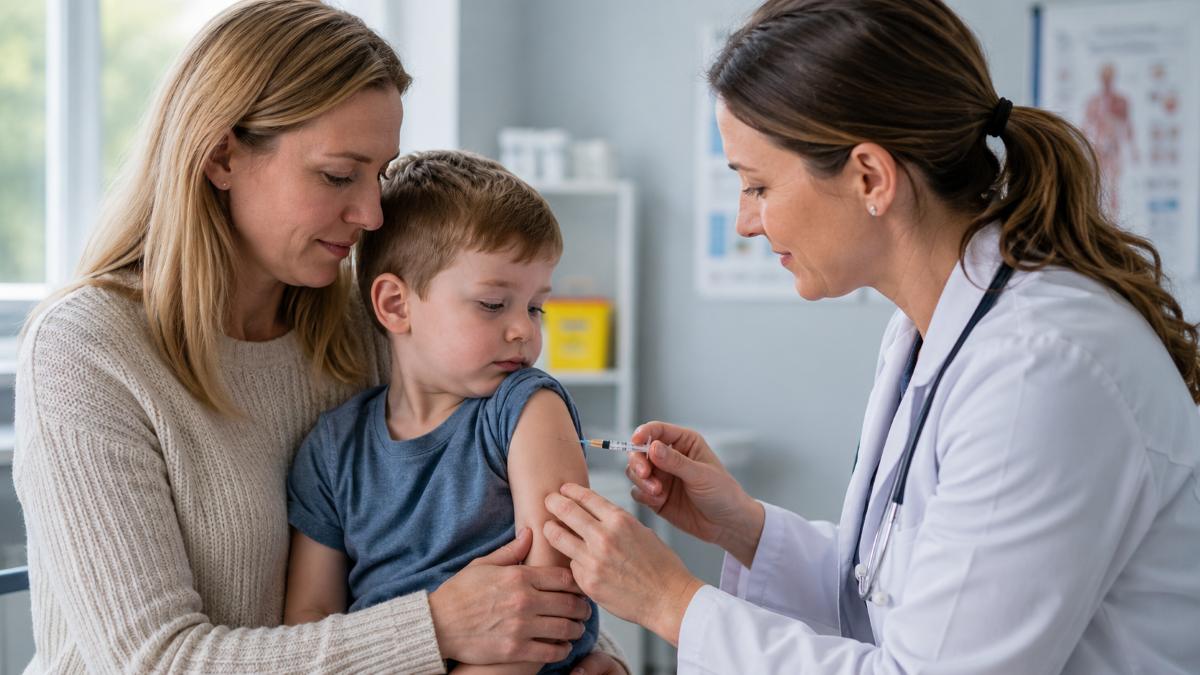
A new measles outbreak has been confirmed in the Amajuba District Municipality as South Africa confronts a sharp decline in childhood vaccination coverage, with national health authorities warning that hundreds of thousands of infants are now being left vulnerable to diseases that vaccines have historically kept under control.
The latest surveillance data from the National Institute for Communicable Diseases (NICD) confirms that Amajuba, which includes Newcastle, Dannhauser and eMadlangeni, has become the latest KwaZulu-Natal district to meet the definition of a laboratory-confirmed measles outbreak.
According to the NICD’s Measles and Rubella Weekly Situation Report for week 33, released on 24 August 2026, an outbreak is recorded when at least three laboratory-confirmed measles cases occur within a health district during a four-week period.
Amajuba recorded three cases between 19 July and 16 August 2026, bringing the district’s total to 23 confirmed measles cases since 29 December 2025.
Read the NICD’s latest Measles and Rubella Situation Report
Across KwaZulu-Natal, the NICD has recorded 93 laboratory-confirmed measles cases during the current reporting period. Of these, 11 involved children younger than one year, while 15 were among children aged one to four and 49 among those aged five to nine.
Nationally, the situation is significantly larger. The NICD’s most recent figures show 3,891 laboratory-confirmed measles cases between 29 December 2025 and 16 August 2026.
A further 144 cases were added in the latest reporting week, including five in KwaZulu-Natal.
Children remain overwhelmingly affected. Of the 3,891 confirmed cases, 2,619, or 67.3%, involved children aged between one and 14 years, while another 477 cases occurred among babies younger than one.
The emergence of the Amajuba outbreak comes as the National Department of Health has sounded an unusually strong warning over South Africa’s deteriorating childhood immunisation rates.
In a statement issued on Wednesday, 26 August 2026, the Department revealed that the proportion of infants under one year receiving no vaccinations at all increased from 12.1% in 2017 to 36.3% between January and April 2026.
In other words, more than one in three infants measured during the latest period had received no vaccinations.
Read the National Department of Health’s full statement
The deterioration is also visible among children who do begin the vaccination schedule.
According to the Department, first-dose vaccination coverage among children younger than one fell from 87% in 2021 to 67% in 2025. Coverage of the Hexavalent, or six-in-one infant vaccine, which protects against several serious diseases, dropped from 87% to 60.5% over the same period.
This national trend has also been independently reflected by international health authorities.
In July 2026, UNICEF and the World Health Organization (WHO) reported that South Africa’s first-dose diphtheria, tetanus and pertussis vaccination coverage had fallen by 20 percentage points since 2019, with the decline continuing during 2025.
The organisations specifically identified South Africa while warning that falling vaccination coverage can result from several factors, including structural challenges and growing vaccine hesitancy.
Read the WHO and UNICEF 2026 immunisation coverage update
Furthermore, measles provides one of the clearest ways of observing what happens when gaps develop in population immunity.
The NICD states that although sporadic measles cases can occur throughout the year, outbreaks usually occur in areas where vaccination coverage is low and significant numbers of children are either unvaccinated or have received only one of the recommended two doses.
The institute’s latest figures demonstrate how vulnerable the youngest children are.
Nationally, babies younger than one recorded the highest measles attack rate at 43.3 cases per 100,000 population.
The NICD explains that infants are particularly vulnerable because they may not yet have received measles vaccination or may have received only one dose.
For measles specifically, WHO and UNICEF state that approximately 95% coverage with both vaccine doses is required to prevent outbreaks of the highly contagious virus.
Moreover, in 2025, global coverage stood at 84% for the first measles dose and only 77% for the second. Fifty-seven countries subsequently experienced large or disruptive measles outbreaks during the year.
The evidence for the impact of vaccination extends considerably further back.
According to the WHO, measles vaccination is estimated to have prevented almost 59 million deaths globally between 2000 and 2024.
Before widespread measles vaccination, major epidemics occurred roughly every two to three years and were responsible for an estimated 2.6 million deaths annually.
Despite the availability of vaccination, an estimated 95,000 people still died from measles worldwide in 2024, with most deaths occurring among unvaccinated or under-vaccinated children younger than five.
Read the WHO’s current measles fact sheet
Measles itself should also not be dismissed as simply a childhood rash.
The NICD warns that infection can result in pneumonia, ear infections, diarrhoea, encephalitis — swelling of the brain — and death.
The disease commonly presents with fever and a widespread rash accompanied by symptoms such as coughing, a runny nose or inflamed eyes.
In addition, the NICD urges healthcare professionals to investigate suspected cases and submit samples for laboratory confirmation.
The National Department of Health has now prioritised catch-up vaccination campaigns targeting children who have missed scheduled doses or remain under-immunised across all districts.
According to the Department, adequate vaccine supplies have been secured and cold-chain infrastructure remains in place nationally.
It further stressed that vaccines used in South Africa are evaluated and registered by the South African Health Products Regulatory Authority (SAHPRA) for safety and effectiveness.
The NICD is particularly encouraging parents and caregivers to check their children’s vaccination cards or Road to Health booklets.
Children younger than five who have missed a scheduled routine measles vaccination should be taken to a healthcare facility or clinic for a catch-up dose as soon as possible, according to the institute.
Beyond protecting the vaccinated child, maintaining high coverage also reduces opportunities for viruses such as measles to circulate through communities and reach infants or people who cannot receive particular vaccinations because of medical conditions.
The National Department of Health has consequently urged South Africans to use official health platforms when seeking vaccination information and to be cautious of unverified health claims circulating on social media.
For residents of Amajuba, the consequences of declining protection against vaccine-preventable disease are no longer a distant national concern.

A laboratory-confirmed measles outbreak has now been recorded within the district itself, while the latest national figures show the immunity gaps behind such outbreaks continuing to widen.
What are your thoughts on this? Let us know below.
While you are here, be sure to read: Five Newcastle clinics included in twice-yearly HIV prevention rollout